Best For
Teams this article is built to help
Category: Behavior Management
Evidence
What backs this guide
This entry reads as practice guidance rather than a source-cited research summary.
Materials
What you can leave with
- Condensed key takeaways
- Primary downloadable resource
- Interactive self-check quiz
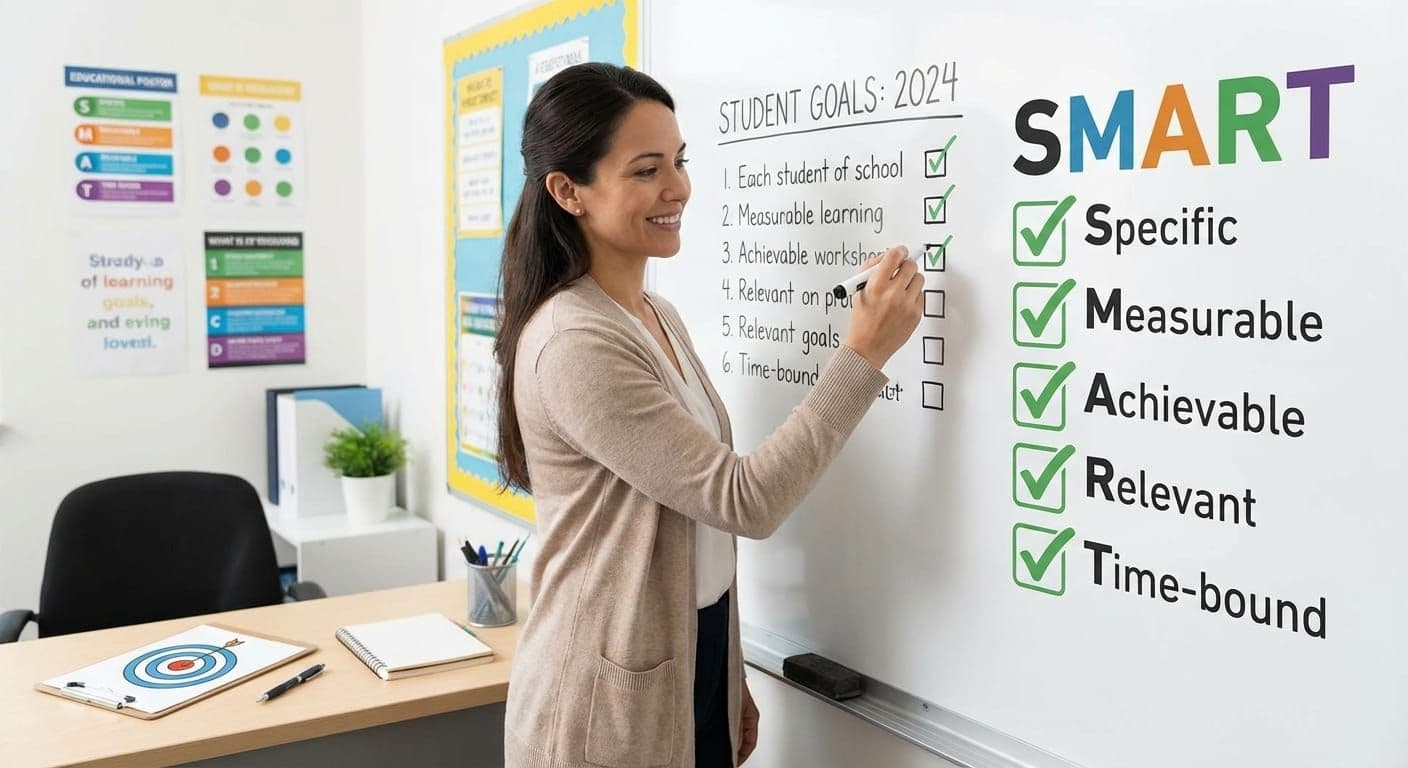
"Marcus will improve his behavior." Most of us have seen an IEP goal like this, and most of us know it cannot be measured. A SMART behavior goal is Specific, Measurable, Achievable, Relevant, and Time-bound: it names an observable behavior, says how it will be measured and how much change counts, and sets a date. The new semester is a natural time to rewrite goals while you have fresh baseline data.
Why Vague Behavior Goals Fall Short
Decades of goal-setting research point the same way: specific, challenging goals tend to produce better performance than vague "do your best" goals (Locke & Latham, 2019). That research comes largely from work settings rather than IEP teams, so treat it as support for the principle, not as a measured success rate for school goals.
There is also a legal reason to be precise. Under the federal IDEA regulations, an IEP must include measurable annual goals, a description of how progress toward them will be measured, and when progress reports will be provided (34 C.F.R. § 300.320(a)(2) and (a)(3)). A goal nobody can measure cannot meet that standard.
Vague Goals That Are Hard to Measure
- "Student will improve behavior in class"
- "Student will be more respectful to peers"
- "Student will reduce aggression"
- "Student will follow directions better"
What is missing: an operational definition, a measurement method, a criterion, a timeline, and a context.
The SMART Framework for Behavior
SMART goals are not new, but applying them to behavior means being clear about what each element means. The student examples in this post are hypothetical and the numbers are illustrative.
Specific
Define the behavior in observable terms so anyone reading the goal pictures the same thing.
Vague: "disruptive behavior"
Specific: "vocalizations above conversational volume during independent work, including yelling, screaming, or singing loudly"
Measurable
Name the dimension you will measure (frequency, duration, latency, percentage) and how you will collect it.
Vague: "reduce yelling"
Measurable: "reduce loud vocalizations from an average of 8 per day to 2 or fewer per day, as measured by daily frequency counts"
Achievable
Base the target on baseline data and the student's developmental level. Stretch, but stay realistic.
Unrealistic: "eliminate all disruptive behavior" (baseline: 40 per day)
Achievable: "reduce from 40 to 20 per day by midyear, then to 10 by year end"
Relevant
The behavior should matter for the student's access to learning or relationships. If you are deciding what is worth a goal, see Choosing Target Behaviors: How to Decide What Is Worth Tracking.
Low relevance: "Student will keep desk organized"
High relevance: "Student will remain in the assigned area during instruction, increasing access to core content"
Time-Bound
Include a date and how long the criterion must hold.
No timeline: "Student will improve compliance"
Time-bound: "By [date], student will follow adult directions within 10 seconds on 80% of opportunities across 3 consecutive data days"
Writing Specific, Observable Goals
The "specific" step trips up most teams. A behavior is observable when two independent observers can watch the same moment and agree on whether it occurred (Cooper et al., 2020).
The Dead Man's Test
If a dead man can do it, it is not a behavior. "Will not hit peers" fails, because a dead man does not hit anyone. "Will use words or walk away when frustrated with peers" passes, because it says what the student will do.
Operational Definition Formula
[Student] will [observable action] + [conditions] + [criteria]
Example: Marcus will raise his hand and wait to be called on (observable action) during whole-group instruction (condition) for 80% of response opportunities across 5 consecutive school days (criteria).
Words to Avoid vs. Words to Use
| Avoid (Subjective) | Use Instead (Observable) |
|---|---|
| Understand | State, explain, demonstrate |
| Appreciate | Thank, acknowledge, express gratitude |
| Be respectful | Use appropriate volume, wait a turn, keep hands to self |
| Improve attitude | Respond to directions within 10 seconds, use a neutral tone |
| Be cooperative | Begin tasks within 30 seconds of instruction, follow 2-step directions |
Measuring Progress Effectively
The measurement system should match the dimension of the behavior that matters most. The wrong measure can hide real progress or lack of it (LeBlanc et al., 2016).
Use frequency when...
- • The behavior has a clear start and end
- • Each instance is about the same length
- • You want to know "how many times"
Examples: hand raising, call-outs, hitting
Use duration when...
- • How long matters more than how often
- • The behavior extends over time
- • You want to know "how much time"
Examples: tantrum length, on-task time, time out of the area
Use latency when...
- • Response time is the concern
- • The behavior happens, but too slowly
- • You want to know "how fast"
Examples: task initiation, delay in following directions
Use percentage when...
- • Opportunities vary from day to day
- • You need to compare across contexts
- • You want to know "what proportion"
Examples: percent of directions followed, participation
Not sure which fits? The comparison in Frequency vs. Duration Tracking walks through the choice.
A Practical Review Rhythm
The right schedule depends on the student and the goal, and the IEP sets when progress reports go home (34 C.F.R. § 300.320). Many teams find a rhythm like this workable:
- Each day or session: collect data on the target behavior
- Weekly: look at the graph and the trend
- At each reporting period: compare progress with the goal and decide whether to adjust the plan
For how to turn that data into a progress report, see Writing IEP Progress Reports for Behavior Goals.
Goal Examples by Behavior Function
Strong plans pair a goal that reduces the problem behavior with a goal that builds the replacement behavior. These hypothetical examples are organized by function. Baselines and criteria are illustrative: set yours from your own data and your team's judgment.
Escape-maintained behavior
Reduction goal:
By [date], when given non-preferred academic tasks, Marcus will reduce work refusal (pushing materials away, saying "no," or putting his head down for 30 seconds or more) from a baseline average of 12 per day to 3 or fewer per day, measured by daily frequency counts over 5 consecutive school days.
Replacement goal:
By [date], when given non-preferred academic tasks, Marcus will request a break using his break card within 30 seconds of task presentation on 80% of opportunities, measured by daily data over 5 consecutive school days.
Attention-maintained behavior
Reduction goal:
By [date], during independent work, Sophia will reduce calling out (verbal comments without raising her hand and being called on) from a baseline of 15 per class period to 3 or fewer, measured by frequency count across 3 consecutive class periods.
Replacement goal:
By [date], during independent work, Sophia will raise her hand and wait quietly to be called on before speaking for 90% of response opportunities, measured across 3 consecutive class periods.
Access to tangibles
Reduction goal:
By [date], when access to a preferred item is denied, Jayden will reduce physical aggression (hitting, kicking, or throwing objects toward others) from a baseline of 5 incidents per week to 1 or fewer, measured by weekly incident counts over 4 consecutive weeks.
Replacement goal:
By [date], when access to a preferred item is denied, Jayden will accept "no" or request an alternative in a complete sentence within 10 seconds on 85% of opportunities, measured by direct observation across 4 consecutive weeks.
A goal is only as good as the function it is built around. If a team has not yet identified why a behavior happens, the goal may need to wait for an assessment. Teachers can find more on the page for teachers.
Common Goal-Writing Mistakes
| Mistake | Why It Is a Problem | How to Fix It |
|---|---|---|
| Only reduction goals | Does not teach what to do instead | Pair each with a replacement-behavior goal |
| Criterion of 100% | Leaves no room for ordinary variability | Set the criterion from baseline and team judgment (many teams use a range like 80-90%); reserve 100% for safety-critical skills |
| No baseline data | You cannot show change without a starting point | Collect several days of baseline before writing the goal |
| Mismatched measurement | The wrong measure hides the real change | Choose frequency, duration, latency, or percentage to match the concern |
| Missing context | The goal may be met in one setting but not where it matters | Name the setting, such as "during math instruction" |
Frequently Asked Questions
What is a SMART goal for behavior?
A SMART behavior goal is Specific (an observable behavior), Measurable (a named measure and criterion), Achievable (realistic given baseline data), Relevant (important to the student's learning or relationships), and Time-bound (a date and a period the criterion must hold). An example: "By [date], the student will follow adult directions within 10 seconds on 80% of opportunities across 3 consecutive data days."
Do IEP behavior goals have to be SMART?
SMART is a planning framework, not a legal term. What federal regulations require is that the IEP include measurable annual goals, a description of how progress will be measured, and when progress reports will be provided (34 C.F.R. § 300.320). Writing goals the SMART way is one practical way to meet that. Short-term objectives or benchmarks are required only for students who take alternate assessments aligned to alternate academic achievement standards, though teams may include them for others. Your state and district may add requirements.
How much baseline data do I need before writing a behavior goal?
There is no fixed number. A few days of consistent data is often enough to see a starting level, and you want enough to see whether the behavior is stable or varies a lot from day to day. If the pattern is unclear, collect more before you set a criterion.
Should a behavior goal say what the student will stop doing?
Usually it should say what the student will do instead. Goals framed only as "will not" tend to fail the dead man's test and do not teach a skill. A reduction goal can still be useful alongside a replacement-behavior goal, so that the team tracks both the problem behavior and the skill that takes its place.
The Bottom Line
SMART goals are not extra paperwork. They give the whole team the same picture of what success looks like and make progress visible.
Start with baseline data. Define the behavior precisely. Set a realistic criterion. Review the data regularly. And include what the student will do instead.
The SMART behavior goal worksheet gives you a blank template with the same structure used in the examples above.
Download the SMART behavior goal worksheetReferences
- Cooper, J. O., Heron, T. E., & Heward, W. L. (2020). Applied behavior analysis (3rd ed.). Pearson.
- LeBlanc, L. A., Raetz, P. B., Sellers, T. P., & Carr, J. E. (2016). A proposed model for selecting measurement procedures for the assessment and treatment of problem behavior. Behavior Analysis in Practice, 9(1), 77-83. https://doi.org/10.1007/s40617-015-0063-2
- Locke, E. A., & Latham, G. P. (2019). The development of goal setting theory: A half century retrospective. Motivation Science, 5(2), 93-105. https://doi.org/10.1037/mot0000127
- Individuals with Disabilities Education Act regulations, 34 C.F.R. § 300.320 (definition of individualized education program). https://www.ecfr.gov/current/title-34/subtitle-B/chapter-III/part-300/subpart-D/section-300.320
Put This Into Practice
Turn the article into action with ready-to-use materials. Downloads stay open; emailed resources and quiz results are opt-in.
Key Takeaways
- Specific, challenging goals tend to outperform vague ones, and IDEA requires IEPs to include measurable annual goals.
- Define the behavior in observable terms that two observers could score the same way.
- Match the measure (frequency, duration, latency, percentage) to the dimension of the behavior that matters.
- Pair each reduction goal with a replacement-behavior goal that says what the student will do instead.
- Set criteria from baseline data and team judgment, and name the setting and the date.
SMART Behavior Goal Worksheet
A fillable worksheet for writing SMART behavior goals with examples for each function of behavior. Includes goal-tracking templates.
Optional email delivery is only for sending this resource and educator updates if you choose them.
Are Your Goals SMART or Just Wishful Thinking?
Find out if your behavior goals would survive a court hearing or crumble under the first "but what does that mean?" question.
Tags:
For classroom teams
Write Goals From Your Baseline Data
Use a blank worksheet to define the behavior, pick a measure, set a criterion, and pair a replacement-behavior goal with each reduction goal.
Download the SMART Behavior Goal WorksheetFree download.
About the Author
Practical guides from the Classroom Pulse team for educators and behavior support teams who collect and use behavior data. Classroom Pulse was founded by Bobby Hillman, M.Ed., LBA, BCBA.
About Classroom PulseRelated Articles
Reading Your Child's IEP Progress Report on a Behavior Goal
A plain-language guide for families: what progress report codes usually mean, the data behind the rating, questions to ask, and what should happen when progress is not enough.
Writing IEP Progress Reports for Behavior Goals: What the Data Should Say
A six-part narrative for IEP progress reports on behavior goals: baseline, current level, trend, measurement, whether progress is sufficient, and what changes next, with examples.
Class Parties, Costume Days, and Assemblies: Planning Behavior Support
Event days stack changed routines, noise, costumes, food, and thin adult structure. Plan them like a new routine, staff them like a transition, and tag them in your data.