Best For
Teams this article is built to help
Category: Behavior Management
Evidence
What backs this guide
Curated references are cited at the end of the article.
Materials
What you can leave with
- Condensed key takeaways
- 3 bonus downloads
- Interactive self-check quiz
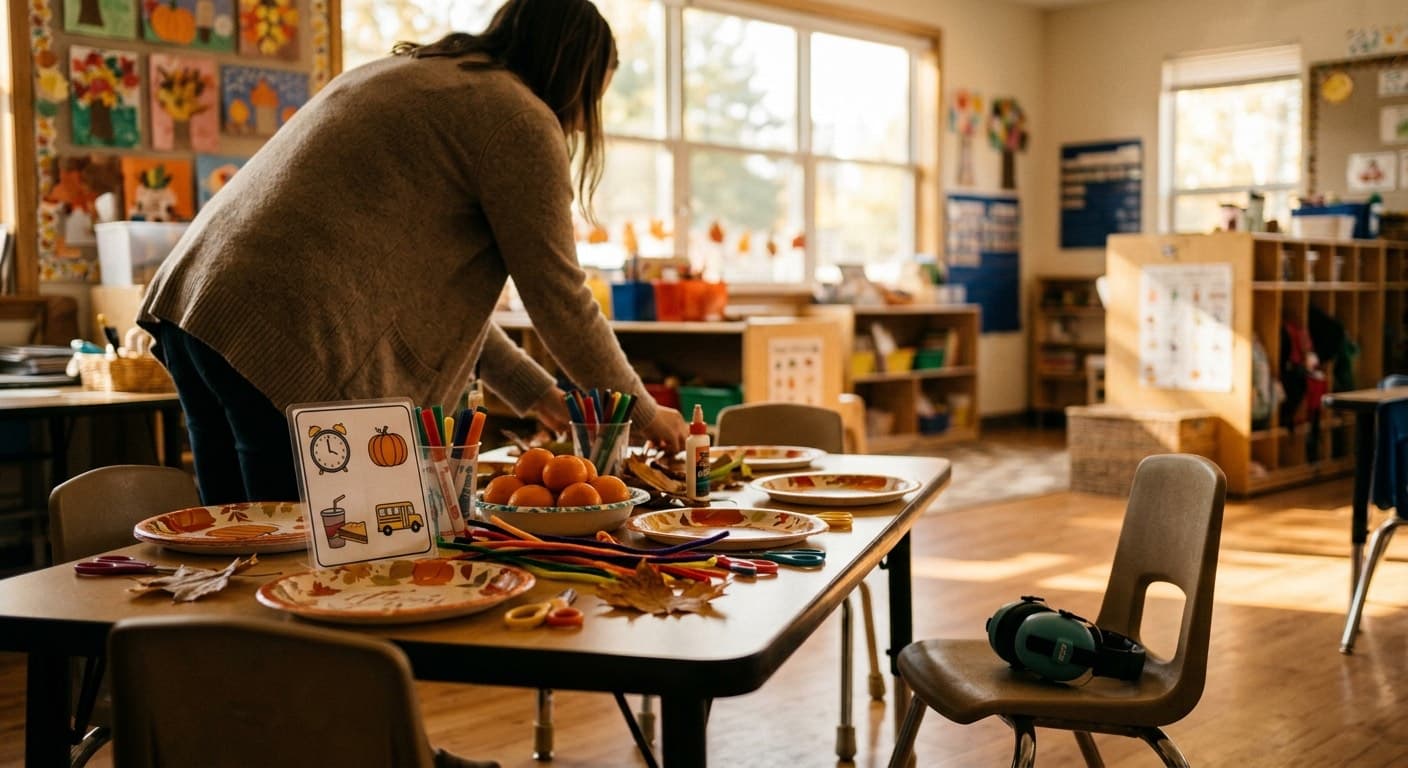
Halloween falls on a Saturday this year, so many schools will hold their parades, costume days, and class parties on Friday, October 30. For a student with a behavior plan, that Friday is not a normal day with candy added. It is a different day, and the plan should treat it that way. Plan an event like a new routine, staff it like a transition, and tag it in your data so a spike reads as context instead of proof that the plan stopped working. The same approach works for assemblies, picture day, field trips, and the winter party coming in December.
Why Event Days Are Hard, in Behavior Terms
Students who do well on ordinary days often struggle at a costume parade or an assembly. That is not mysterious. A school event changes several things at once, and many of them are the exact conditions a behavior plan was built around.
- The routine changes. The visual schedule no longer matches the day, specials may be canceled, and transitions happen at unfamiliar times.
- Noise and crowding go up. A gym full of classes, a hallway parade, or a packed cafeteria adds sound, movement, and bodies close together.
- Costumes add sensory load. Masks narrow vision, face paint and stiff fabric feel strange, and familiar peers and adults suddenly look different.
- Food changes the rules. Treats are a powerful item to wait for, share, or lose, and food brings allergies, unfamiliar textures, and more waiting.
- Expectations get vague. "It's a party" does not tell a student where to stand, how loud is okay, or when it ends.
- Adult structure thins out. Staff are setting up, supervising extra students, or covering for each other, so the adult who usually prompts the plan may be across the room.
Behavior analysts describe part of this with the idea of motivating operations: conditions that change how valuable a consequence is at that moment, and so change how likely the behavior that produces it becomes (Laraway et al., 2003). In a loud gym, getting out of the room becomes more valuable than usual, so escape-maintained behavior is more likely. When every adult is busy, attention is scarce and worth more. When a bowl of candy sits on the table, access to it suddenly matters a great deal. The student has not changed. The value of the consequences has.
Event days also act as setting events: background conditions that make the usual triggers hit harder. A demand that a student handles every Tuesday can become the last straw after forty minutes of parade noise.
An Event Is Several Antecedents Stacked Together
Instead of asking "Will Friday be a hard day?", ask which parts of Friday line up with what you already know about this student. If the plan says transitions and loud spaces are the hard routines, an assembly is both. That tells you where to put your supports.
Preview, Prime, and Make the Day Visible
The most useful work happens before the event, and most of it is ordinary antecedent intervention: changing what comes before behavior so the student is more likely to succeed.
Preview and prime
Priming means letting a student preview an activity before it happens, in a calm moment, with low demands. In one small study, previewing upcoming class assignments with two students with autism in general education classrooms was associated with less problem behavior and more academic responding (Koegel et al., 2003). The same logic applies to events. A day or two ahead, walk the parade route, visit the gym where the assembly will be, show a photo of the classroom set up for the party, or let the student see your costume before Friday morning. On the morning itself, preview again.
Put the event on the schedule
If a student uses a visual schedule, update it to show the real day, including the event, how long it lasts, and what comes after. A clear "change" symbol is better than pretending the day is normal. A systematic review of activity schedules for children with autism found reductions in challenging behavior across the studies it reviewed, with weaker effects in general education classrooms than in separate settings (Lequia et al., 2012). Treat the schedule as one support among several, not the whole plan.
Teach what the event looks like, then remind right before
"Be good at the assembly" is not an expectation a student can follow. "Sit at the end of the row next to Ms. Okafor, hands in your lap, and when the music stops we walk back" is. Teach the expectation for each part of the event, then give a short reminder right before each transition into it. That reminder is a precorrection, and the federal practice guide on teacher-delivered behavioral interventions rates both teaching clear expectations and reminding students of them as strong-evidence recommendations (Lane et al., 2024). In one elementary school, when staff precorrected and actively supervised during building-wide transitions, problem behavior during those transitions dropped substantially (Colvin et al., 1997).
Vague
"We're having a party this afternoon, so I need everyone to make good choices."
Specific and Previewed
"At 1:30 the party starts. You'll be at the craft table first, then snacks. If it gets too loud, show me your break card and we'll go to the library corner. The party ends when the timer rings at 2:15."
Breaks, Choices, Food, and Families Who Do Not Celebrate
Schedule breaks before they are needed
For a student who struggles with noise or crowds, a break that arrives after escalation is a rescue. A break that is scheduled into the event is a support. Pick a quiet space ahead of time (a library corner, the counselor's office, an empty classroom), make sure an adult can be there, and decide how the student gets back. If the student already has sensory supports such as headphones or a movement break, plan for them to be available during the event, not left in the classroom. The sensory regulation and transition supports your team already uses are exactly what an assembly calls for.
Offer real choices
Offering choices is a moderate-evidence recommendation in the same practice guide (Lane et al., 2024), and event days are full of easy ones:
- Full costume, part of a costume (a hat, a color theme), or no costume
- Watch the parade from the curb or from a doorway with more space
- Sit at the end of the row near the exit, or next to a preferred adult
- Join for the first part of the party, then choose a calmer activity
- Take a job: passing out napkins, holding the door, running the music, taking photos for the class
Jobs deserve special mention. They give a student structure inside an unstructured hour, a legitimate reason to move, and a natural source of adult attention for doing something helpful.
Plan the food
Check allergy and dietary plans with the school nurse and families before the day, not at the snack table. Tell students in advance what food will be there and how it will be shared, so the wait and the portion size are not a surprise. Have a non-food option ready for students who cannot or should not eat what is served.
Plan a good alternative for families who do not celebrate
Some families do not celebrate Halloween or certain holidays for religious, cultural, or personal reasons. Ask early and privately, and plan an alternative that is genuinely good: a book and art activity with another class, a job in the library, or a fall-themed activity in the classroom. It should not feel like a holding room, the student should not have to explain why, and a student with a behavior plan needs the same supports in the alternative setting as anywhere else.
A Staffing Plan for the Event Hour
Event-day plans tend to come apart when nobody in particular is responsible for the student. Write a one-page plan that names adults, not roles in general. A five-minute huddle the morning of the event is enough to walk through it.
| Role | What this adult does |
|---|---|
| Point person | Knows the plan, stays near the student, gives the precorrections, watches for early signs, and offers the planned break. |
| Break escort | Goes with the student to the quiet space so the point person can stay with the group if needed. |
| Room supervisor | Moves, scans, and interacts with the rest of the class so one adult is not trying to do everything. |
| Recorder | Logs incidents and supports used during or right after the event, with the event tag on every entry. |
| Backup | Covers if the point person or a paraprofessional is pulled to help elsewhere. Decide this in advance. |
Volunteers and visiting family members are part of the room too. They do not need the student's plan, and confidentiality means they should not get it. Give them one simple instruction instead: "If a student needs help, find Ms. Okafor." If the student does escalate, follow the crisis and de-escalation plan you already have, and decide ahead of time where the student goes and who comes along. Teachers coordinating several students with plans can find more classroom workflows on our page for teachers.
Tag Event Days So the Data Tells the Truth
This step is easy to skip, and it matters most a month from now. If a student has four incidents on October 30 and the graph shows only a spike, someone in November will ask whether the plan is failing. If every entry from that day carries the note "costume parade and party," the same spike reads as what it was: a known setting event.
How to Tag an Event Day
- Use the same words every time. Pick a short tag ("assembly," "party," "picture day," "field trip") so you can find those days later.
- Tag the whole day, not just the incidents. A calm event day is useful data. Write "party day, no incidents" if that is what happened.
- Log the supports, too. Was the preview done? Was the break offered? Without this, nobody can tell whether a hard day means the supports did not work or were not in place.
- Keep the antecedent specific. "Party" is the setting event. "Asked to wait for a turn at the snack table" is the antecedent.
Consider a hypothetical second grader we'll call Malik. Over the year, his team tags six event days: an assembly in September, picture day, the October 30 party, a fire safety assembly, a field trip, and the winter party. By January they can see that Malik's hard moments cluster during waiting in crowded spaces, and that the two event days with a scheduled break and a job had no incidents. That is a plan for the spring assembly, built from his own data.
A paper setting event checklist works well for this. If your team logs in Classroom Pulse, the preset antecedent options capture the immediate trigger and the note on each entry can hold the event tag. With "Include notes in PDF" turned on, that tag travels into the PDF report your team brings to the next meeting. Before that PDF goes to anyone outside the team, check the notes for classmates' names, the same privacy check described in our conference guide.
When you review the graph, resist changing a plan because of one tagged spike. Ask instead: did behavior return to its usual range the next school day? Were the event supports in place? If event days stay hard even with supports, revise the event plan. If ordinary days are rising too, that is a different conversation, and a real one for the team.
Frequently Asked Questions
Should a student with a behavior plan skip the party?
Not by default. Most students can take part with planned supports, partial participation, or a job. Removing a student from a class celebration as a consequence for something earlier in the day can create a new hard moment without solving the old one. If the team thinks a different arrangement makes sense, decide it with the family before the day, not in the moment.
What if the student wants to wear a mask that limits vision?
Check your school's costume policy first. Then offer a choice that keeps the costume and the student's vision: wear the mask for the parade photo, then switch to face paint, a hat, or a headband. Practice the switch ahead of time so it is part of the plan, not a correction.
How do I collect data while I'm also running the party?
Simplify for the hour. A tally of the target behavior and a one-line note with the event tag is enough. If you have to write entries afterward, do it as soon as the event ends and say so in the note. An honest "recorded at 2:20, after the party" is better than a reconstructed entry that looks live.
Does this apply beyond Halloween?
Yes. Assemblies, picture day, field trips, concerts, field day, and the December party all change routines, noise, and adult structure in similar ways. Building the plan once and reusing it for each event is the efficient move.
Plan the Day, Then Read the Data in Context
Event days are predictable. You know the date, the location, and roughly what will happen, which means you can plan for them the same way you plan for any hard routine: preview it, make it visible, schedule the breaks, name the adults, and write down what happened with the event attached.
Start with Friday, October 30. Sketch the plan for one student this week, and use it again for the winter party.
References
Colvin, G., Sugai, G., Good, R. H., III, & Lee, Y. (1997). Using active supervision and precorrection to improve transition behaviors in an elementary school. School Psychology Quarterly, 12(4), 344-363. https://doi.org/10.1037/h0088967
Koegel, L. K., Koegel, R. L., Frea, W., & Green-Hopkins, I. (2003). Priming as a method of coordinating educational services for students with autism. Language, Speech, and Hearing Services in Schools, 34(3), 228-235. https://doi.org/10.1044/0161-1461(2003/019)
Lane, K. L., Baldy, T., Becker, T., Bradshaw, C., Dolan, V., Dymnicki, A., Freeman, B., Holian, L., Lemire, S., McIntosh, K., Moulton, S., Nese, R., Payno-Simmons, R., Porowski, A., & Sutherland, K. (2024). Teacher-delivered behavioral interventions in grades K-5 (WWC 2025001). National Center for Education Evaluation and Regional Assistance, Institute of Education Sciences, U.S. Department of Education. https://ies.ed.gov/ncee/WWC/PracticeGuide/31
Laraway, S., Snycerski, S., Michael, J., & Poling, A. (2003). Motivating operations and terms to describe them: Some further refinements. Journal of Applied Behavior Analysis, 36(3), 407-414. https://doi.org/10.1901/jaba.2003.36-407
Lequia, J., Machalicek, W., & Rispoli, M. J. (2012). Effects of activity schedules on challenging behavior exhibited in children with autism spectrum disorders: A systematic review. Research in Autism Spectrum Disorders, 6(1), 480-492. https://doi.org/10.1016/j.rasd.2011.07.008
Put This Into Practice
Turn the article into action with ready-to-use materials. Downloads stay open; emailed resources and quiz results are opt-in.
Key Takeaways
- An event day changes routines, noise, sensory load, food, expectations, and adult structure all at once, so plan it like a new routine
- Preview the event ahead of time, put it on the visual schedule, and give a specific reminder right before each transition into it
- Schedule breaks and a staffed quiet space before they are needed, offer real choices, and plan a good alternative for families who do not celebrate
- Name the adults: a point person, a break escort, a room supervisor, a recorder, and a backup if someone is pulled away
- Tag every entry from an event day with the same short note and log the supports used, so a spike reads as a setting event rather than a failed plan
Bonus Materials
Clean downloads to pair with this article
Download resources directly or send a copy to your inbox. Marketing updates are optional.
Setting Event Checklist
Daily check-in that includes assemblies, special schedules, and extended unstructured time
Proactive Behavior Planning Template
Known triggers, warning signs, and proactive strategies on one planning page
Break and Transition Toolkit
Transition warnings, visual supports, and a break request system
Is Your Team Ready for Event Day?
Check how your plan for parties, costume days, and assemblies lines up with the practices in this guide.
Tags:
For classroom teams
Log Event Days Alongside Everyday Data
Record ABC entries with preset antecedent options and add an event note that can carry into your PDF reports.
Create Your Free AccountFree for up to 3 students. No credit card required.
About the Author
Bobby Hillman is a Board Certified Behavior Analyst and Licensed Behavior Analyst with an M.Ed. in Special Education and more than 25 years in public special education and autism services. He works as a Behavior Instructional Specialist and founded Classroom Pulse to reduce the documentation load on classroom teams while keeping the detail FBA and BIP work requires.
About Classroom PulseRelated Articles
Student Privacy Questions to Ask Before You Buy Behavior Data Software
Written questions for behavior data vendors, grouped by topic: FERPA, COPPA, state law, the DPA, subprocessors, AI training, access for paras and subs, logs, breach, and deletion.
Reading Your Child's IEP Progress Report on a Behavior Goal
A plain-language guide for families: what progress report codes usually mean, the data behind the rating, questions to ask, and what should happen when progress is not enough.
Writing IEP Progress Reports for Behavior Goals: What the Data Should Say
A six-part narrative for IEP progress reports on behavior goals: baseline, current level, trend, measurement, whether progress is sufficient, and what changes next, with examples.