Best For
Teams this article is built to help
Category: Research & Insights
Evidence
What backs this guide
This entry reads as practice guidance rather than a source-cited research summary.
Materials
What you can leave with
- Condensed key takeaways
- Primary downloadable resource
- Interactive self-check quiz
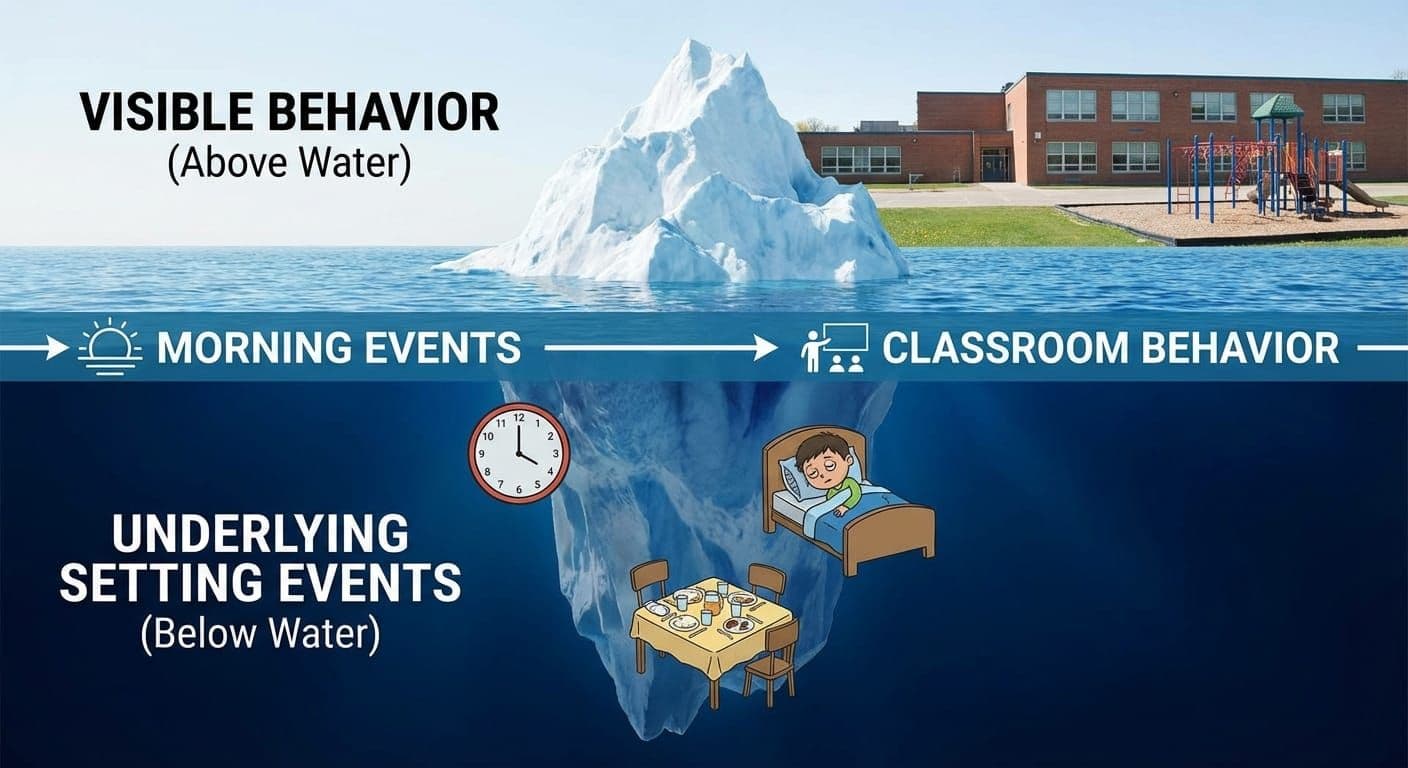
He's always perfect on Wednesdays but a nightmare on Mondays. Coincidence? Not according to research. Setting events, the often-invisible contextual factors that happen before we even see the student, explain why the same trigger produces dramatically different results on different days.
What Are Setting Events?
Setting events are contextual factors that alter the value of reinforcers and punishers. More simply: things that happen earlier that make behavior more or less likely later.
Also called establishing operations, antecedent events, or contextual variables, setting events are the "hidden variable" in the behavior equation.
Why We Miss Setting Events
- • They happen minutes, hours, or even days before the behavior
- • Teachers rarely witness them (happened at home, on bus, earlier class)
- • They're "invisible": you see the behavior, not the context
Research on Sleep and Behavior
Insufficient sleep is a common and well-documented setting event:
More
problem behaviors when students are short on sleep
Same
triggers, dramatically different outcomes based on sleep
Illness and allergy symptoms can increase escape-maintained behavior. The environment didn't change; the student's internal state did.
The Research on Setting Event Impact
The Magnitude of Effect
Many
severe incidents have setting events present
More
intense when setting events present
Reduced
intervention effectiveness if ignored
Common Setting Events by Category
Biological
- • Sleep deprivation
- • Hunger/skipped meals
- • Illness/pain
- • Medication changes
Social
- • Conflict at home
- • Parent stress at drop-off
- • Peer conflict earlier
Environmental
- • Schedule changes
- • Substitute teacher
- • Weather/barometric pressure
- • Disrupted routine
The Multiplicative Effect
Setting events don't cause behavior alone; they multiply the effect of immediate antecedents.
Formula: Typical antecedent + Setting event = substantially more likely behavior
Hypothetical Classroom Examples
Example 1: The Monday Pattern
Student profile: Elementary student with sensory support needs
Problem: Aggressive behavior appears more often on Mondays
Initial Hypothesis: Weekend regression? Monday routine?
Setting Event Discovery:
- Weekend routine differs from school-night routine
- Sleep and sensory factors may be relevant
- Monday transition demands may need adjustment
Intervention to Review:
Family communication plus a Monday reset routine with sensory support and lower initial task demands.
Evidence to monitor: whether Monday incidents become less frequent or less intense.
Example 2: Health-Related Setting Events
Student profile: Upper elementary student with attention and anxiety support needs
Problem: Aggressive episodes seem sporadic
Initial Hypothesis: Attention-seeking? Escape from math?
Setting Event Discovery:
- ABC data alone shows no clear pattern
- Team begins tracking health and fatigue context
- Episodes appear more likely on high-symptom days
Intervention to Review:
Coordinate with caregivers and school health staff, modify expectations on high-symptom days, and teach a help-request signal.
Evidence to monitor: whether high-symptom days need different proactive supports.
Example 3: Arrival Routine Context
Student profile: Primary student with behavior support needs
Problem: Arrives to school already escalated on some mornings
Initial Hypothesis: Doesn't want to be at school?
Setting Event Discovery:
- Team reviews arrival notes and transportation context
- Peer conflict before school may be contributing
- Classroom behavior starts before the student enters the room
Intervention to Review:
Adjust transportation supports, add a morning reset routine, and document arrival context consistently.
Evidence to monitor: whether arrival support changes reduce morning escalation patterns.
Key Learning
Behavior "starts" long before we see it. Without setting event data, these patterns would have been missed entirely.
How to Track Setting Events Effectively
Planned schedule changes count too. Class parties, costume days, assemblies, and field trips are setting events you can see coming; planning behavior support for unstructured school events covers how to prepare for them and tag them in your data.
Strategy 1: The Setting Event Checklist
Structured checklists make it much easier to identify setting events.
Pre-loaded options like "Missed breakfast," "Sleep issues," "Family conflict" take 10 seconds to check vs. 2 minutes to write notes.
Strategy 2: Pattern Recognition Retrospectively
A retrospective approach works well:
- Collect ABC data first (12-18 incidents)
- Review for "outliers": incidents that don't fit the pattern
- THEN investigate setting events for those outliers
Strategy 3: Parent Communication Loop
Parents are often a reliable source of information about setting events.
Quick Morning Check-In Options
- • "Anything different about this morning?"
- • Daily 2-question form: "How was [child's] night?" (Scale 1-5) + "Anything unusual?" (Yes/No)
- • Traffic light system: Parent signals "red day" "yellow day" or "green day"
Strategy 4: Cross-Setting Data Sharing
Multi-setting data improves hypothesis accuracy. Coordinate with bus driver, breakfast supervisor, previous-period teacher: "Heads up: Meltdown in lunch, seems tired."
Setting Events by Behavior Function
Setting events interact differently with behavior function:
Escape-Maintained Behaviors
Most affected by:
- • Task difficulty perception
- • Sleep deprivation
- • Previous academic failure that day
Attention-Maintained Behaviors
Most affected by:
- • Lack of adult attention that morning
- • Peer rejection earlier
- • Parent drop-off with conflict
Tangible-Maintained Behaviors
Most affected by:
- • Denied access to preferred item at home
- • Saw peer with desired item
- • Holiday/birthday anticipation
Sensory-Maintained Behaviors
Most affected by:
- • Illness/physical discomfort
- • Sensory-overload event earlier
- • Weather changes
Intervening with Setting Events
There are three main intervention approaches:
Approach 1: Neutralize the Setting Event
Change the condition that creates the setting event.
Note: Can be highly effective, but often outside teacher control
Examples: Bus seating changes, morning snack provision, family bedtime coordination
Approach 2: Modify Triggers in Response to Setting Events
You can't control if he had a bad morning, but you can adjust demands.
Note: Frequently effective
Traffic Light System: "Red day" = low demands, high support, frequent breaks
Approach 3: Teach Coping Skills
Student learns to manage their own response to setting events.
Note: Effective, but takes time to establish
Examples: Self-advocacy ("I need a break"), sensory regulation strategies
The Layered Approach
Combining approaches tends to yield the strongest results:
- 1. Neutralize what you can
- 2. Modify environment when setting event present
- 3. Teach self-management
Result: Comprehensive, resilient intervention
The Bottom Line
Setting events are the "hidden variable" in behavior analysis. When teams ignore them, they may miss context that changes which intervention is most appropriate.
The students who seem "unpredictable" often have very predictable setting event patterns. Modern tools make tracking practical, not burdensome.
References
McGill, P., Teer, K., Rye, L., & Hughes, D. (2005). Staff reports of setting events associated with challenging behavior. Behavior Modification, 29(4), 599-615. https://doi.org/10.1177/0145445505274391
Horner, R. H., Albin, R. W., Todd, A. W., Newton, J. S., & Sprague, J. R. (2011). Designing and implementing individualized positive behavior support. In M. E. Snell & F. Brown (Eds.), Instruction of students with severe disabilities (7th ed., pp. 257-303). Pearson.
McIntosh, K., Horner, R. H., Chard, D. J., Dickey, C. R., & Braun, D. H. (2008). Reading skills and function of problem behavior in typical school settings. The Journal of Special Education, 42(3), 131-147. https://doi.org/10.1177/0022466907313253
Carr, E. G., & Smith, C. E. (1995). Biological setting events for self-injury. Mental Retardation and Developmental Disabilities Research Reviews, 1(2), 94-98. https://doi.org/10.1002/mrdd.1410010205
Langdon, P. E., Murphy, G. H., Clare, I. C. H., Steverson, T., & Palmer, E. J. (2011). Relationships among moral reasoning, empathy, and distorted cognitions in men with intellectual disabilities and a history of criminal offending. American Journal on Intellectual and Developmental Disabilities, 116(6), 438-456. https://doi.org/10.1352/1944-7558-116.6.438
Put This Into Practice
Turn the article into action with ready-to-use materials. Downloads stay open; emailed resources and quiz results are opt-in.
Key Takeaways
- Setting events are present in 64% of severe behavior incidents (Snodgrass et al., 2021)
- When setting events are present, behaviors are 2.4x more intense
- Ignoring setting events reduces intervention effectiveness by 52%
- Sleep deprivation correlates with 78% of increased problem behaviors (Lydon et al., 2022)
- Structured checklists increase setting event identification by 247%
Setting Events Tracking Template
A comprehensive checklist of biological, social, and environmental setting events with tracking sheets and parent communication templates.
Optional email delivery is only for sending this resource and educator updates if you choose them.
Are You a Setting Events Detective or Missing the Hidden Clues?
Find out if you're catching the invisible factors that make "bad days" happen, or still wondering why Mondays are always worse.
Tags:
For classroom teams
Put this into practice with your own data
Log behaviors as they happen, see the pattern on a graph, and bring a clear summary to your next team meeting.
Track Setting Events FreeFree for up to 3 students. No credit card required.
About the Author
Practical guides from the Classroom Pulse team for educators and behavior support teams who collect and use behavior data. Classroom Pulse was founded by Bobby Hillman, M.Ed., LBA, BCBA.
About Classroom PulseRelated Articles
Writing IEP Progress Reports for Behavior Goals: What the Data Should Say
A six-part narrative for IEP progress reports on behavior goals: baseline, current level, trend, measurement, whether progress is sufficient, and what changes next, with examples.
Before the FBA Referral: A Four-Week Data Packet Classroom Teams Can Build
What a classroom team can gather in about four weeks so an FBA referral starts from evidence: a definition, baseline, ABC entries, a time-of-day grid, and what was tried.
Class Parties, Costume Days, and Assemblies: Planning Behavior Support
Event days stack changed routines, noise, costumes, food, and thin adult structure. Plan them like a new routine, staff them like a transition, and tag them in your data.