Best For
Teams this article is built to help
Category: FBA & Data Collection
Evidence
What backs this guide
Curated references are cited at the end of the article.
Materials
What you can leave with
- Condensed key takeaways
- Primary downloadable resource
- Interactive self-check quiz
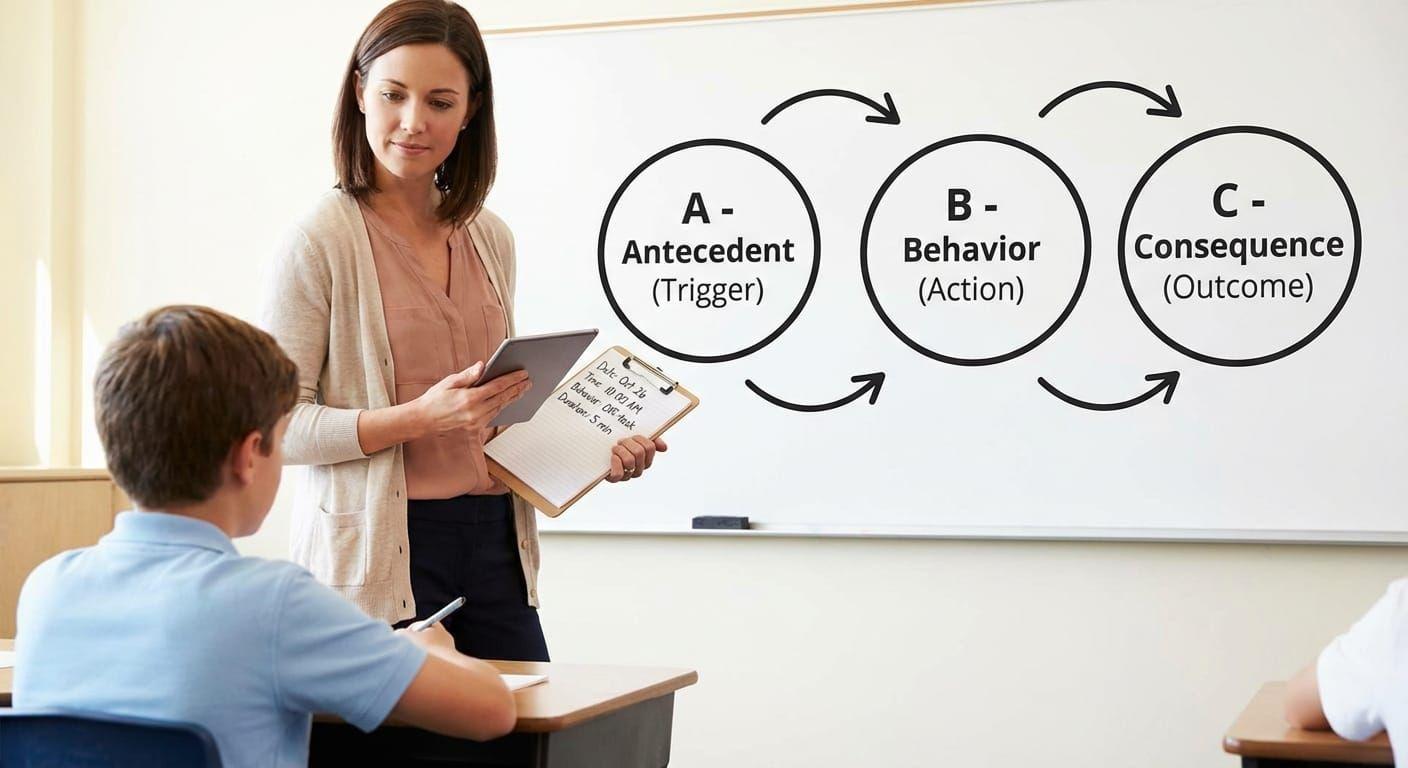
You've logged 47 incidents of "disruption" this month. But do you know WHY they're happening? Simple frequency counts tell you what's occurring, but ABC data (Antecedent, Behavior, Consequence) tells you why. And that "why" is everything when it comes to designing interventions that actually work.
The Research Foundation
ABC data collection isn't just a best practice. It's backed by decades of rigorous research demonstrating its superiority over simple behavior counts.
Key Research Findings
Function Over Topography
Behavior function, not topography (what the behavior looks like), is what determines intervention effectiveness. Most behaviors serve one of a small number of core functions across diverse student populations.
Functional Communication Training
Teaching functionally equivalent replacement behaviors can substantially reduce problem behaviors. Function identification accuracy is closely tied to intervention success.
Consistent Digital Data Collection
ABC data collected via digital platforms is more likely to correctly identify function when collected consistently than with inconsistent paper-based methods.
The message from research is clear: understanding why a behavior occurs is more important than knowing how often it occurs.
Why Simple Frequency Data Falls Short
Consider this scenario: A student hits peers 3 times daily. Your frequency data shows a consistent pattern: 3 incidents per day, every day. But what should your intervention be?
Scenario A: Escape Function
ABC Data Reveals: All 3 hits occur during math, immediately after difficult problems are presented. After hitting, the student is sent to the office (escaping the math task).
Intervention: Break cards, math scaffolding, teach "help" requests
Scenario B: Attention Function
ABC Data Reveals: All 3 hits occur during independent work when the teacher is helping other students. After hitting, the student receives immediate one-on-one attention (lecture/redirection).
Intervention: Scheduled check-ins, attention for appropriate behavior, peer buddy system
Same Behavior, Opposite Interventions
Frequency data shows "3 hits per day" in both scenarios: identical numbers. But the interventions are completely different, even contradictory. Using the wrong intervention could make the behavior worse.
The Research Evidence
- • Function-based interventions are more effective than topography-based approaches
- • Interventions are far more likely to fail when function isn't identified prior to implementation
The Power of the "A" and "C"
In ABC data, antecedents predict when behavior will occur, while consequences maintain (reinforce) the behavior over time.
Antecedents Predict
Predictable antecedent patterns often emerge after a modest number of observations when using modern data visualization. Common antecedent patterns include:
- Specific academic demands (math worksheets, writing tasks)
- Transitions between activities
- Removal of preferred items or activities
- Periods of low adult attention
- Specific times of day or settings
Consequences Maintain
Setting events can multiply the likelihood of behavior occurring. But consequences determine whether the behavior continues. Ask: What does the student "get" after the behavior?
Classroom Application Example
Hypothetical pattern: A team notices that outbursts often follow peer-to-peer instructions and usually result in adult help arriving immediately.
- Data-driven hypothesis: Attention-seeking from adults (missed by frequency alone)
- Intervention shift: Adult check-ins every 15 minutes during peer work
- Evidence to review: Whether behavior decreases after proactive adult check-ins are added
Common ABC Data Collection Mistakes
Mistake #1: Vague Antecedents
❌ Too Vague: "During class"
✓ Specific: "Given worksheet with 20 multi-digit multiplication problems"
Mistake #2: Not Recording Setting Events
Setting events are frequently present in high-intensity incidents. Did the student sleep poorly? Skip breakfast? Have a conflict at home? These contextual factors matter.
Mistake #3: Inconsistent Collection
Reliable pattern identification requires collecting enough data points consistently. Sporadic collection leads to incomplete pictures and incorrect hypotheses.
Making ABC Data Practical
The 3-Minute Problem
Requiring detailed narrative notes makes it much harder for teachers to keep up with data collection. Teachers simply don't have time to write paragraphs after every incident.
The Solution: Pre-Loaded Options
Digital platforms with dropdown menus transform ABC data collection:
3 min
Paper-based narrative notes
25 sec
Digital pre-loaded options
Data Visualization Matters
Visual analysis with automated graphing substantially reduces interpretation time. Instead of manually reviewing dozens of incident reports, patterns emerge instantly in charts showing:
- Most common antecedents
- Most common consequences
- Time-of-day patterns
- Setting/location correlations
Team Collaboration
Multi-observer ABC data increases function identification accuracy. When multiple staff members contribute observations, blind spots disappear.
From Data to Hypothesis to Intervention
The goal of ABC data isn't data collection. It's function identification leading to effective intervention.
The Function-Based Thinking Process
- 1 Collect 15-20 ABC data points
- 2 Analyze patterns in antecedents and consequences
- 3 Form hypothesis about function (attention, escape, tangible, sensory)
- 4 Design intervention targeting that specific function
- 5 Measure effectiveness and adjust as needed
Success Metrics
Most function-based interventions produce meaningful behavior reduction within weeks. The key: The function hypothesis must drive the intervention, not assumptions about what "should" work.
Quick Reference: The 4 Behavior Functions
Attention
Behavior gets a reaction from others
Common antecedent: Low attention, independent work
Common consequence: Adult redirection, peer reaction
Escape
Behavior removes an aversive demand or situation
Common antecedent: Difficult task, non-preferred activity
Common consequence: Task removed, sent out of class
Tangible
Behavior gains access to items or activities
Common antecedent: Denied access, preferred item visible
Common consequence: Gets the item/activity
Sensory/Automatic
Behavior feels good internally
Common antecedent: Various (not tied to external events)
Common consequence: Internal reinforcement
The Bottom Line
ABC data is the gold standard for a reason: decades of research prove it. Simple frequency data tells you WHAT is happening. ABC data tells you WHY. And when you know WHY, you can design interventions that actually work.
Modern digital tools remove the "too time-consuming" barrier. What once took 3 minutes per incident now takes 25 seconds. What once required hours of manual analysis now generates insights automatically.
Not sure where to start? Your own hallway observations are the raw material; see turning 'he always melts down after lunch' into usable ABC data.
References
Bijou, S. W., Peterson, R. F., & Ault, M. H. (1968). A method to integrate descriptive and experimental field studies at the level of data and empirical concepts. Journal of Applied Behavior Analysis, 1(2), 175–191. https://doi.org/10.1901/jaba.1968.1-175
Lerman, D. C., & Iwata, B. A. (1993). Descriptive and experimental analyses of variables maintaining self-injurious behavior. Journal of Applied Behavior Analysis, 26(3), 293–319. https://doi.org/10.1901/jaba.1993.26-293
Miltenberger, R. G. (2016). Behavior modification: Principles and procedures (6th ed.). Cengage Learning.
Newcomer, L. L., & Lewis, T. J. (2004). Functional behavioral assessment: An investigation of assessment reliability and effectiveness of function-based interventions. Journal of Emotional and Behavioral Disorders, 12(3), 168–181. https://doi.org/10.1177/10634266040120030401
Thompson, R. H., & Borrero, J. C. (2011). Direct observation. In W. W. Fisher, C. C. Piazza, & H. S. Roane (Eds.), Handbook of applied behavior analysis (pp. 191–205). Guilford Press.
Put This Into Practice
Turn the article into action with ready-to-use materials. Downloads stay open; emailed resources and quiz results are opt-in.
Key Takeaways
- Function-based interventions are 3.2x more effective than topography-based approaches (Rispoli et al., 2021)
- ABC data collected via digital platforms correctly identifies function in 81% of cases (Rooker et al., 2020)
- The same behavior can require opposite interventions depending on its function; context reveals the difference
- Minimum 12-20 ABC data points are needed for reliable pattern identification
- Pre-loaded digital options reduce collection time from 3 minutes to 25 seconds per incident
ABC Data Collection Cheat Sheet
A quick-reference guide with common antecedents, behaviors, and consequences organized by function. Includes examples and red flags to watch for.
Optional email delivery is only for sending this resource and educator updates if you choose them.
Are You Collecting Data or Just Counting to Feel Busy?
Find out if your ABC data is revealing the "why" behind behavior or just documenting the obvious.
Tags:
For classroom teams
Put this into practice with your own data
Log behaviors as they happen, see the pattern on a graph, and bring a clear summary to your next team meeting.
Start Collecting ABC Data FreeFree for up to 3 students. No credit card required.
About the Author
Practical guides from the Classroom Pulse team for educators and behavior support teams who collect and use behavior data. Classroom Pulse was founded by Bobby Hillman, M.Ed., LBA, BCBA.
About Classroom PulseRelated Articles
Writing IEP Progress Reports for Behavior Goals: What the Data Should Say
A six-part narrative for IEP progress reports on behavior goals: baseline, current level, trend, measurement, whether progress is sufficient, and what changes next, with examples.
Before the FBA Referral: A Four-Week Data Packet Classroom Teams Can Build
What a classroom team can gather in about four weeks so an FBA referral starts from evidence: a definition, baseline, ABC entries, a time-of-day grid, and what was tried.
From 'He Always Melts Down After Lunch' to Usable ABC Data
Five real-sounding hallway anecdotes translated step-by-step into ABC log entries, and how a few weeks of honest entries turn instinct into a testable pattern.