Best For
Teams this article is built to help
Category: FBA & Data Collection
Evidence
What backs this guide
Curated references are cited at the end of the article.
Materials
What you can leave with
- Condensed key takeaways
- Primary downloadable resource
- 2 bonus downloads
- Interactive self-check quiz
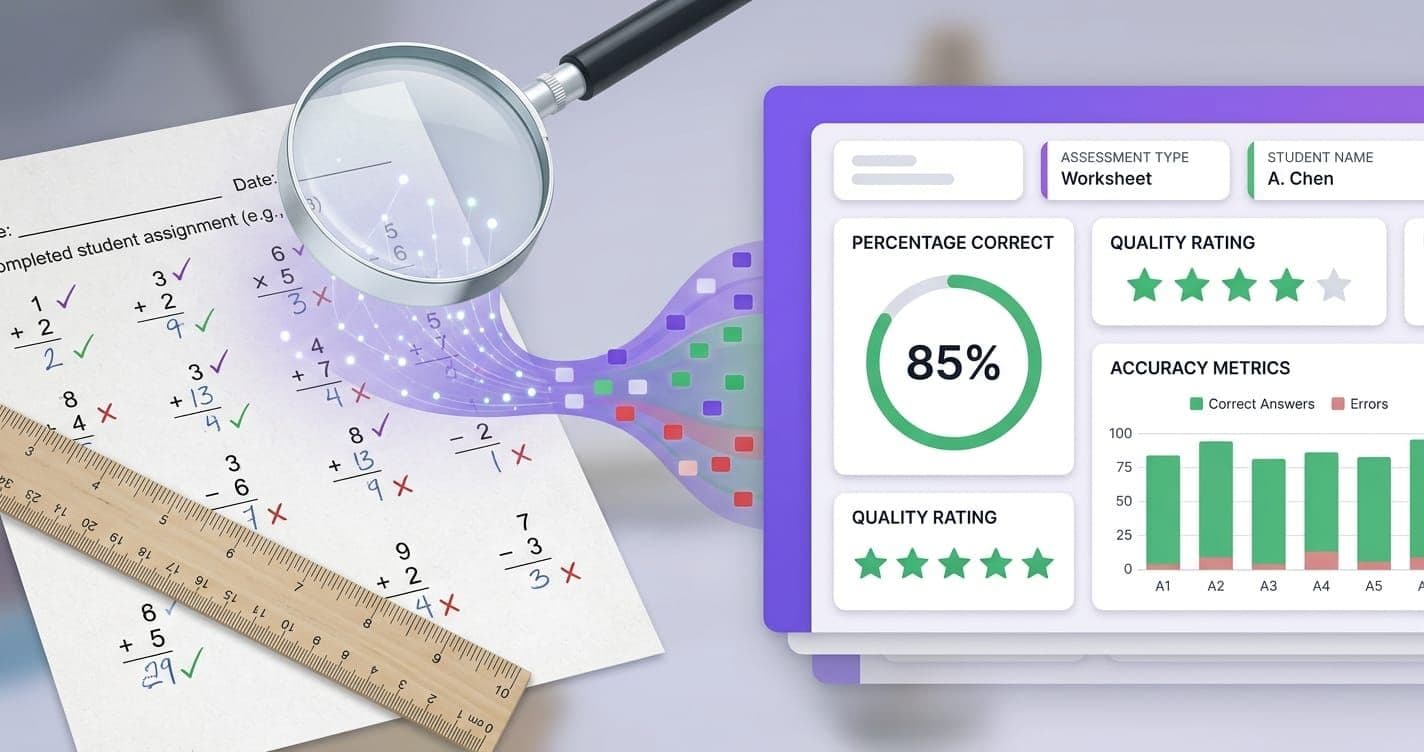
Permanent product recording measures the lasting result of behavior after the behavior has occurred. A completed worksheet, a scored writing sample, a damaged item, or an organized desk can all provide useful data when the product is clearly tied to the target behavior and the scoring rules are consistent.
The method test
Use permanent product recording when the outcome remains long enough to score, the product can be tied to a defined behavior, and the team does not need moment-by-moment information about when or how the behavior occurred.
Decide Whether Permanent Product Recording Is a Good Fit
Permanent product recording is strongest when the team cares about the outcome of behavior and can score that outcome later. It is weaker when timing, duration, escalation sequence, or context is the main question.
| Good Fit | Why It Works | Possible Measure |
|---|---|---|
| Completed academic work | The work remains after the session and can be scored later. | Number correct, percent correct, completion rate. |
| Written response quality | The product can be scored with a rubric if criteria are clear. | Rubric score, number of required elements, error count. |
| Property damage | The outcome may remain visible after the behavior occurs. | Item count, repair cost category, photo evidence note. |
| Routine completion | Completed steps can be checked after the routine. | Steps complete, percent complete, independence level. |
Define the Product and Scoring Unit
The product is not the same as the behavior. The team must define exactly what will be scored and what each score means. This protects data quality when different adults score the same product.
Weak Definition
- "Good work completion"
- "Desk is clean"
- "Student wrote enough"
- "Property destruction happened"
Useful Definition
- "Number of assigned math problems completed and correct."
- "Five desk organization items in correct location at 2:45 p.m."
- "Number of complete sentences with subject and predicate."
- "Number of classroom materials torn, broken, or unusable after incident."
Definition Checklist
- What product will be collected or reviewed?
- When will it be scored?
- What counts as complete, correct, damaged, organized, or independent?
- Will the scorer need the original product, a photo, a scan, or a checklist?
- What should the scorer do when the product is missing or partly completed?
Choose Count, Percentage, Rubric, or Quality Criteria
Different products require different scoring rules. Choose the simplest score that answers the team's question.
| Scoring Type | Use When | Example |
|---|---|---|
| Count | The product can be counted directly. | 14 correct problems, 3 broken pencils, 6 completed steps. |
| Percentage | The total number of opportunities changes across sessions. | 18 of 20 correct equals 90 percent accuracy. |
| Rubric | Quality matters and count alone is not enough. | Writing sample scored 0-3 for topic sentence, detail, grammar, and closure. |
| Independence Level | The team needs to know whether prompts are fading. | Completed with no prompt, verbal prompt, model, or physical assistance. |
Know What This Method Cannot Tell You
Permanent product data can be highly efficient, but it is not a substitute for every observation method. The product rarely tells the full story by itself.
It Usually Cannot Tell You
- Exactly when the behavior occurred.
- How long the behavior lasted.
- What happened immediately before or after.
- Whether the student completed the product independently.
- Whether the process included distress, avoidance, or adult prompting.
Pair It With
- ABC notes when context and function are unclear.
- Duration recording when length of episode matters.
- Latency recording when start time after a prompt matters.
- Prompt-level data when independence is the goal.
- Fidelity checks when adult implementation may explain the product.
Build Agreement Checks Into Scoring
Permanent products often make agreement easier because scorers can review the same product. Agreement still depends on clear rules. If two adults score a writing rubric differently, the method needs calibration.
Simple Agreement Check
- Have two scorers independently score the same product.
- Compare the count, percentage, rubric score, or independence rating.
- Review disagreements and revise scoring rules if needed.
- Repeat after the product type, assignment format, or scorer changes.
| Agreement Problem | Likely Fix |
|---|---|
| Scorers disagree on whether an answer is correct. | Add answer key rules and examples of partial credit. |
| Rubric scores vary widely. | Use anchor examples for each score level. |
| Products are missing or altered before scoring. | Set a collection routine and photo/scan backup process. |
Use a Simple Classroom Workflow
A permanent product system should be easy to repeat. The team needs to know what to save, who scores it, where scores are recorded, and when the data will be reviewed.
1. Collect
Save the product or photo at the same point in the routine.
2. Score
Use the agreed count, percentage, rubric, or independence criteria.
3. Note Context
Add short notes for missing work, absences, prompting, or unusual routines.
4. Review
Compare product data with goals, fidelity, and direct observation when needed.
Choose the Right Measurement Method
Use the method selection pocket card and direct observation reference to decide when permanent product recording is enough and when the team needs direct observation data.
References
Briesch, A. M., Chafouleas, S. M., & Riley-Tillman, T. C. (2016). Direct behavior rating: Linking assessment, communication, and intervention. Guilford Press.
Chafouleas, S. M., Kilgus, S. P., Riley-Tillman, T. C., Jaffery, R., Christ, T. J., Briesch, A. M., Chanese, J. A. M., & Kalymon, K. M. (2013). An evaluation of the generalizability of direct behavior rating single-item scales to measure academic engagement across raters and observations. School Psychology Review, 42(4), 407–421.
Volpe, R. J., & Briesch, A. M. (2012). Generalizability and dependability of single-item and multiple-item direct behavior rating scales for engagement and disruptive behavior. School Psychology Review, 41(3), 246–261.
Smith, T. E., Thompson, A. M., & Maynard, B. R. (2022). Self-management interventions for reducing challenging behaviors among school-age students: A systematic review. Campbell Systematic Reviews, 18(1), e1223. https://doi.org/10.1002/cl2.1223
Ruble, L. A., McGrew, J. H., Wong, W. H., & Missall, K. N. (2018). Special education teachers' perceptions and intentions toward data collection. Journal of Early Intervention, 40(2), 177–191. https://doi.org/10.1177/1053815118771391
Hanley, G. P., Iwata, B. A., & McCord, B. E. (2003). Functional analysis of problem behavior: A review. Journal of Applied Behavior Analysis, 36(2), 147–185. https://doi.org/10.1901/jaba.2003.36-147
Iwata, B. A., Dorsey, M. F., Slifer, K. J., Bauman, K. E., & Richman, G. S. (1994). Toward a functional analysis of self-injury. Journal of Applied Behavior Analysis, 27(2), 197–209. https://doi.org/10.1901/jaba.1994.27-197
Newcomer, L. L., & Lewis, T. J. (2004). Functional behavioral assessment: An investigation of assessment reliability and effectiveness of function-based interventions. Journal of Emotional and Behavioral Disorders, 12(3), 168–181. https://doi.org/10.1177/10634266040120030401
Ingram, K., Lewis-Palmer, T., & Sugai, G. (2005). Function-based intervention planning: Comparing the effectiveness of FBA function-based and non-function-based intervention plans. Journal of Positive Behavior Interventions, 7(4), 224–236. https://doi.org/10.1177/10983007050070040401
Scott, T. M., Alter, P. J., & McQuillan, K. (2010). Functional behavior assessment in classroom settings: Scaling down to scale up. Intervention in School and Clinic, 46(2), 87–94. https://doi.org/10.1177/1053451210374986
Put This Into Practice
Turn the article into action with ready-to-use materials. Downloads stay open; emailed resources and quiz results are opt-in.
Key Takeaways
- Permanent product recording works when the outcome remains long enough to score and is clearly tied to the target behavior
- The team must define the product, scoring unit, collection time, and rules for missing or partial products
- Counts, percentages, rubrics, and independence ratings each answer different measurement questions
- Permanent product data usually cannot show timing, duration, antecedents, or prompting unless the team records those separately
- Agreement checks still matter because rubric scores, partial credit, and missing products can create scoring drift
Measurement Selection Pocket Card
A quick reference for choosing event, duration, latency, interval, permanent product, and other behavior measurement methods.
- Method selection prompts
- Behavior dimension examples
- Classroom-friendly measurement notes
This resource is available without registration.
Bonus Materials
Clean downloads to pair with this article
Download resources directly or send a copy to your inbox. Marketing updates are optional.
Measurement Selection Pocket Card
Use this pocket reference to decide when IRT is worth the added observer burden.
IOA Calculation Worksheets
Practice calculating agreement across common behavior measurement formats.
Can You Use Permanent Product Recording Well?
Check whether you know when permanent product recording fits, how to score products, and when direct observation is still needed.
Tags:
For school-based BCBAs
See how it works in Classroom Pulse
Log behaviors as they happen, see patterns on a graph, and share clear summaries with your team.
Explore Data CollectionAbout the Author
Practical guides from the Classroom Pulse team for educators and behavior support teams who collect and use behavior data. Classroom Pulse was founded by Bobby Hillman, M.Ed., LBA, BCBA.
About Classroom PulseRelated Articles
Before the FBA Referral: A Four-Week Data Packet Classroom Teams Can Build
What a classroom team can gather in about four weeks so an FBA referral starts from evidence: a definition, baseline, ABC entries, a time-of-day grid, and what was tried.
Legally Defensible Behavior Data: What School Psychologists Need From Classroom Teams
What makes behavior data hold up under review: shared operational definitions, in-the-moment recording, one consistent measurement dimension, and FERPA-safe storage.
From 'He Always Melts Down After Lunch' to Usable ABC Data
Five real-sounding hallway anecdotes translated step-by-step into ABC log entries, and how a few weeks of honest entries turn instinct into a testable pattern.