Best For
Teams this article is built to help
Category: Administrator Resources
Evidence
What backs this guide
Curated references are cited at the end of the article.
Materials
What you can leave with
- Condensed key takeaways
- 1 bonus download
- Interactive self-check quiz
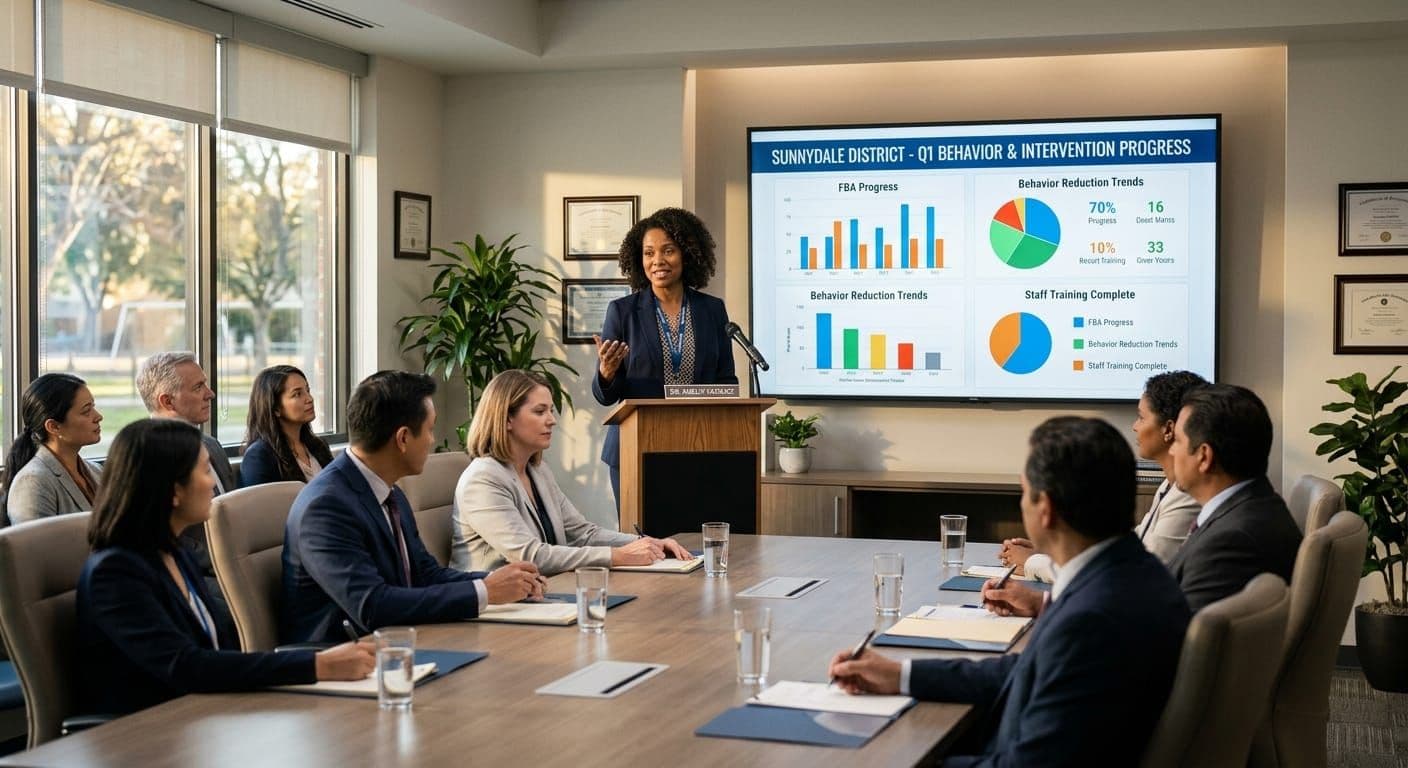
School board members do not need a behavior-data workshop. They need a clear public briefing that helps them understand student safety, instructional time, legal risk, resource needs, and whether the district's support system is improving.
A useful board presentation translates internal behavior data into a decision-ready story: what changed, why it matters, what the district is doing, what risks remain, and what action leaders need from the board.
The Board-Ready Storyline
Before building slides, answer one question: What decision or oversight responsibility are we helping the board fulfill? The answer determines what belongs in the presentation.
1. Context
What prompted the update? Annual report, resource request, safety concern, policy review, disproportionality monitoring, or program evaluation.
2. Trend
What changed over time? Show the fewest data points needed to make the direction and magnitude understandable.
3. Meaning
Why should a non-specialist care? Translate counts into safety, learning time, staff capacity, compliance, or budget implications.
4. Response
What is the district doing? Name the 2-3 highest-leverage actions, not every program or committee involved.
5. Risk
What remains unresolved? Call out implementation gaps, staffing constraints, data limitations, or equity concerns honestly.
6. Ask
What do you need from the board? Approval, direction, budget support, policy alignment, or awareness before future action.
A Useful Opening Line
"Tonight's behavior data update is not a list of incidents. It is a progress report on student safety, instructional access, and the supports we are using to reduce preventable disruption."
Seven-Slide Board Deck Outline
Most board updates should fit into 10-15 minutes. If the deck needs more than seven core slides, the story is probably not focused enough.
Slide 1: Bottom Line
State the main message in one sentence. Example: "Major behavior incidents are down 18% from last spring, but middle school hallway incidents remain above target and require staffing and supervision changes."
Slide 2: What We Measure and Why
Define each metric in plain language: major incidents, instructional time lost, suspensions, repeated incidents, restraint or seclusion events if applicable, and staff response time.
Slide 3: District Trend
Show one simple trend chart comparing the current period to the same period last year. Add a one-sentence takeaway above the chart.
Slide 4: Where Support Is Needed
Show patterns by grade band, location, time of day, or support tier. Avoid naming individual students, teachers, or classrooms in public materials.
Slide 5: What We Are Doing
Connect each action to a pattern: hallway supervision for transition spikes, coaching for referral inconsistency, small-group supports for repeated incidents, or crisis prevention training for safety events.
Slide 6: What We Are Watching
Name the risks you will monitor next: disproportionality, repeat incidents, staff injury, restraint reduction, referral quality, training coverage, or student re-entry after suspension.
Slide 7: Board Action or Next Update
Close with a specific ask or a specific follow-up date. Do not end with "Any questions?" before telling the board what action you need.
Plain-Language Slide Examples
Board members should not have to decode special education vocabulary, behavior terminology, or internal acronyms. Every slide needs a plain-language headline that explains the meaning of the data.
| Internal wording | Board-ready wording | Why it works |
|---|---|---|
| ODRs increased during unstructured settings. | Incidents increased during hallway transitions and lunch, when supervision routines are hardest to maintain. | Replaces acronym-heavy language with concrete locations and conditions. |
| Tier 2 fidelity is inconsistent. | Some students who need extra support are not receiving that support consistently enough to know whether it is working. | Explains the student impact instead of naming the framework. |
| FBAs and BIPs are delayed. | For students with repeated serious incidents, assessment and support-plan timelines are taking longer than our target. | Keeps legal/process terms secondary and centers timeliness. |
| Implementation fidelity improved 20%. | Staff are following support plans more consistently, which gives students a better chance to practice replacement skills. | Turns a technical implementation measure into an outcome story. |
Strong Slide Headline
"Lost instructional time decreased after we added targeted hallway supervision."
This tells the board what the chart means before they inspect the numbers.
Weak Slide Headline
"Behavior Data, Q3."
This labels the topic but does not explain the insight.
What Data Belongs in the Board Packet?
The board packet should include enough evidence for oversight without becoming an internal case-management file. Use aggregate data in public materials and keep student-level detail in protected internal systems.
Usually Helpful
- District or school-level trend over time
- Comparison to the same period last year
- Instructional time recovered or lost
- Suspension trends and re-entry supports
- High-level location or time-of-day patterns
- Staff training completion and coaching coverage
- Actions taken and dates for follow-up review
Usually Not Appropriate
- Student names, initials, photos, or identifiable case details
- Small-cell data that could identify a student or staff member
- Teacher-by-teacher comparison charts in public session
- Raw incident narratives copied from internal systems
- Speculation about student motivation or family circumstances
- Charts that imply blame without explaining system response
- Unreviewed AI summaries or unvalidated dashboard exports
Privacy and Equity Guardrails
A board presentation can create value only if it protects students and improves decisions. Run these checks before sharing behavior data publicly.
Privacy Check
Remove any detail that could reasonably identify a student, especially in small programs, grade levels, or specialized classrooms. When in doubt, aggregate further or discuss details in the appropriate confidential setting.
Small-Cell Check
If a subgroup has very few students, do not publish the count in a way that makes individuals identifiable. Combine categories, show rates only when defensible, or move the detail into a protected internal review.
Equity Check
Look for disproportionate referral, suspension, restraint, or exclusion patterns by race, disability status, multilingual learner status, gender, grade band, and school. If a gap appears, name the review process and next action.
Definition Check
Confirm that schools are using the same incident definitions before comparing campuses. Inconsistent referral definitions can make one school look worse simply because staff document more consistently.
Action Check
Every risk shown to the board should have an owner, timeline, and review date. Publicly naming a concern without naming the response erodes trust.
What Not to Say
Board presentations can accidentally sound defensive, punitive, or too technical. Prepare safer wording before the meeting, especially for questions about safety, cost, special education, and discipline.
| Avoid saying | Say instead |
|---|---|
| "Those students are causing most of the problems." | "A small number of students need more intensive and consistent support. We are tracking whether those supports reduce repeat incidents." |
| "The data is bad because teachers do not document correctly." | "We are improving documentation consistency through clearer definitions, staff calibration, and dashboard review routines." |
| "We cannot talk about that because of FERPA." | "We cannot discuss individual student details in public session, but we can share the aggregate trend and the system response." |
| "We just need more staff." | "The data shows supervision gaps during specific times. We are requesting targeted staffing and schedule changes tied to those patterns." |
| "This program works." | "The early indicators are moving in the right direction, and we will review impact again after a full implementation cycle." |
Prepare for Board Questions
Strong answers acknowledge the concern, translate the data, and return to the action plan. Avoid debating individual anecdotes in the public meeting.
"Are students and staff safe?"
"Safety is the first measure we review. Serious incidents are [up/down] compared with the same period last year, and we are monitoring repeat incidents, injury reports, and response time. The main action this month is [specific action], and we will review the next trend update on [date]."
"Why are we spending more on behavior support?"
"The cost is tied to prevention and capacity, not just response. The goal is fewer crises, fewer lost instructional hours, fewer exclusionary discipline events, and fewer expensive emergency placements. We will track whether the investment changes those indicators."
"Why are suspension numbers changing?"
"Suspension numbers need context. We look at safety, repeat incidents, student re-entry, instructional time, and equity patterns together. A lower suspension count is meaningful only if safety and learning conditions are also improving."
"Can you tell us what happened with the student people are talking about?"
"We cannot discuss individual student information in public session. What we can share is the district process: immediate safety response, parent communication, support-plan review, and follow-up monitoring. Tonight's data is presented at the aggregate level to protect student privacy."
One-Page Board Brief
Give board members a one-page brief they can reference after the meeting. It should be clear enough for a community member to understand without the slide deck.
Briefing Template
Purpose
Why the board is receiving this update and what decision, oversight duty, or future action it supports.
Bottom Line
One sentence that states the main trend and its meaning for students, staff, or resources.
Three Evidence Points
Use only the strongest data points: trend over time, comparison to target or prior year, and the most important unresolved pattern.
Actions Underway
List 2-3 current actions with owner, timeline, and how success will be measured.
Privacy and Equity Review
State that public data is aggregated and that the district reviewed subgroup patterns before presenting conclusions.
Board Ask or Next Update
Clarify whether the board is being asked to approve, advise, monitor, fund, or simply receive the update.
Turn Behavior Data Into a Board-Ready Brief
A board presentation is only as strong as the data behind it. Use consistent definitions, timely documentation, and review routines so your public update reflects real trends instead of last-minute spreadsheet cleanup.
References
Ruble, L. A., McGrew, J. H., Wong, W. H., & Missall, K. N. (2018). Special education teachers' perceptions and intentions toward data collection. Journal of Early Intervention, 40(2), 177–191. https://doi.org/10.1177/1053815118771391
Kearns, D. M., Feinberg, N. J., & Anderson, L. J. (2021). Implementation of data-based decision-making: Linking research from the special series to practice. Journal of Learning Disabilities, 54(5), 365–372. https://doi.org/10.1177/00222194211032403
U.S. Department of Education, Privacy Technical Assistance Center. (2015). Data governance checklist. https://studentprivacy.ed.gov/resources/data-governance-checklist
U.S. Department of Education. (2021). FERPA general guidance for parents and eligible students. https://studentprivacy.ed.gov/
Blue-Banning, M., Summers, J. A., Frankland, H. C., Lord Nelson, L., & Beegle, G. (2004). Dimensions of family and professional partnerships: Constructive guidelines for collaboration. Exceptional Children, 70(2), 167–184. https://doi.org/10.1177/001440290407000203
Sheridan, S. M., Smith, T. E., Kim, E. M., Beretvas, S. N., & Park, S. (2019). A meta-analysis of family-school interventions and children’s social-emotional functioning: Moderators and components of efficacy. Review of Educational Research, 89(2), 296–332. https://doi.org/10.3102/0034654318825437
Lei, H., Cui, Y., & Chiu, M. M. (2016). Affective teacher-student relationships and students’ externalizing behavior problems: A meta-analysis. Frontiers in Psychology, 7, 1311. https://doi.org/10.3389/fpsyg.2016.01311
Put This Into Practice
Turn the article into action with ready-to-use materials. Downloads stay open; emailed resources and quiz results are opt-in.
Key Takeaways
- A strong board presentation follows a decision-ready storyline: context, trend, response, evidence, risk, and next action
- Every slide should translate behavior data into plain-language meaning for non-specialist decision-makers
- Privacy and equity checks belong in the preparation process before any chart reaches a public board packet
- Board members need specific asks, honest limitations, and a one-page briefing they can reference after the meeting
Bonus Materials
Clean downloads to pair with this article
Download resources directly or send a copy to your inbox. Marketing updates are optional.
Behavior Data Review Template
Use this review template to prepare trend data, red flags, action owners, and follow-up notes before building a board-facing briefing.
Will Your Board Presentation Inform, or Confuse?
Assess whether your data communication approach works for non-specialist audiences.
Tags:
For school and district leaders
See how it works in Classroom Pulse
Log behaviors as they happen, see patterns on a graph, and share clear summaries with your team.
Explore Data CollectionAbout the Author
Practical guides from the Classroom Pulse team for educators and behavior support teams who collect and use behavior data. Classroom Pulse was founded by Bobby Hillman, M.Ed., LBA, BCBA.
About Classroom PulseRelated Articles
Student Privacy Questions to Ask Before You Buy Behavior Data Software
Written questions for behavior data vendors, grouped by topic: FERPA, COPPA, state law, the DPA, subprocessors, AI training, access for paras and subs, logs, breach, and deletion.
Reading Your Child's IEP Progress Report on a Behavior Goal
A plain-language guide for families: what progress report codes usually mean, the data behind the rating, questions to ask, and what should happen when progress is not enough.
Writing IEP Progress Reports for Behavior Goals: What the Data Should Say
A six-part narrative for IEP progress reports on behavior goals: baseline, current level, trend, measurement, whether progress is sufficient, and what changes next, with examples.