Best For
Teams this article is built to help
Category: FBA & Data Collection
Evidence
What backs this guide
Curated references are cited at the end of the article.
Materials
What you can leave with
- Condensed key takeaways
- 1 bonus download
- Interactive self-check quiz
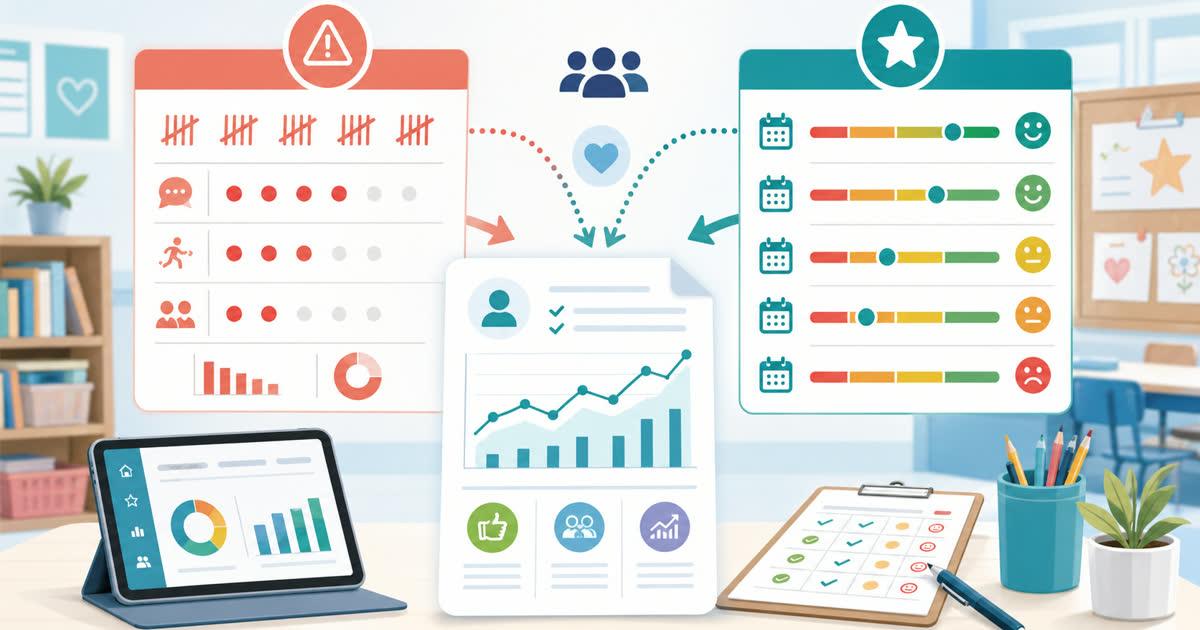
Incident counts answer one question: how often did a defined behavior occur? Daily behavior ratings answer a different question: how well did the student demonstrate a broader goal during a routine, period, or day? Both can be valid. The mistake is using one method to answer the other method’s question.
Quick Rule
Use counts for events. Use ratings for performance across time. Use both when a team needs to understand severity, context, and daily functioning.
When Incident Counts Are Strong
Counts work well when the behavior has a clear beginning and end. They are especially important for safety, legal, or intervention-review questions where the team needs to know whether a specific event is increasing or decreasing.
- Physical aggression
- Elopement attempts
- Property destruction events
- Calling out
- Break requests or replacement communication attempts
When Daily Ratings Are Strong
Ratings are useful when the behavior is not a clean countable event or when the team needs feedback across a whole routine. Direct Behavior Rating research supports brief ratings for areas such as academic engagement and disruptive behavior when the scale is clearly defined.
Good Rating Targets
Engagement, respect, work completion, participation, transition success, use of replacement skill.
Weak Rating Targets
Vague traits such as attitude, motivation, manipulation, or being good.
Anchor the Rating
A rating scale needs anchors so staff rate the same way. Without anchors, a 3 from one teacher may mean the same thing as a 1 from another teacher.
2: Met expectation independently for most of the period.
1: Met expectation with reminders, prompts, or partial support.
0: Did not meet expectation yet or needed significant adult support.
Use Both for a Better Story
Counts and ratings together can explain progress more accurately. A student may have one incident but show improved engagement for most of the day. Another student may have few incidents because adults avoided demands, while ratings show low independence.
| Data Pattern | Possible Interpretation |
|---|---|
| Incidents down, ratings up | Intervention may be working |
| Incidents down, ratings still low | Behavior reduced, but skill or engagement still needs support |
| Incidents stable, ratings up | Progress may be emerging before the target behavior drops |
References
Briesch, A. M., Chafouleas, S. M., & Riley-Tillman, T. C. (2016). Direct behavior rating: Linking assessment, communication, and intervention. Guilford Press.
Chafouleas, S. M., Kilgus, S. P., Riley-Tillman, T. C., Jaffery, R., Christ, T. J., Briesch, A. M., Chanese, J. A. M., & Kalymon, K. M. (2013). An evaluation of the generalizability of direct behavior rating single-item scales to measure academic engagement across raters and observations. School Psychology Review, 42(4), 407-421.
Lane, K. L., Baldy, T., Becker, T., Bradshaw, C., Dolan, V., Dymnicki, A., Freeman, B., Holian, L., Lemire, S., McIntosh, K., Moulton, S., Nese, R., Payno-Simmons, R., Porowski, A., & Sutherland, K. (2024). Teacher-Delivered Behavioral Interventions in Grades K-5. What Works Clearinghouse. https://ies.ed.gov/ncee/WWC/PracticeGuide/31/Published
Put This Into Practice
Turn the article into action with ready-to-use materials. Downloads stay open; emailed resources and quiz results are opt-in.
Key Takeaways
- Incident counts are useful for discrete behaviors and safety events
- Daily behavior ratings are useful for engagement, disruption, respect, and goal feedback
- Ratings should be anchored to observable examples, not vague impressions
- Combining ratings with incident data gives teams a more complete picture
- Parent reports should explain what the score means and what support comes next
Bonus Materials
Clean downloads to pair with this article
Download resources directly or send a copy to your inbox. Marketing updates are optional.
Direct Observation Methods Reference
A quick guide to behavior measurement methods
Which Behavior Data Method Should You Use?
Test your understanding of when to use daily behavior ratings versus incident counts for different behavior tracking scenarios.
For classroom teams
See how it works in Classroom Pulse
Log behaviors as they happen, see patterns on a graph, and share clear summaries with your team.
Compare Behavior Data MethodsAbout the Author
Practical guides from the Classroom Pulse team for educators and behavior support teams who collect and use behavior data. Classroom Pulse was founded by Bobby Hillman, M.Ed., LBA, BCBA.
About Classroom PulseRelated Articles
Student Privacy Questions to Ask Before You Buy Behavior Data Software
Written questions for behavior data vendors, grouped by topic: FERPA, COPPA, state law, the DPA, subprocessors, AI training, access for paras and subs, logs, breach, and deletion.
Reading Your Child's IEP Progress Report on a Behavior Goal
A plain-language guide for families: what progress report codes usually mean, the data behind the rating, questions to ask, and what should happen when progress is not enough.
Writing IEP Progress Reports for Behavior Goals: What the Data Should Say
A six-part narrative for IEP progress reports on behavior goals: baseline, current level, trend, measurement, whether progress is sufficient, and what changes next, with examples.